The purpose of the blog is to document my external learning of Developmental Biology. Enjoy!

Sunday, November 16, 2014

The Brain


Use the photo above in reference to the definitions given below.

Pons - This is a part of the brainstem. It is located between the midbrain and medulla oblongata. The pons develop from the metencephalon. Some of its functions include the sense such as taste and hearing, and touch. It also functions in equilibrium, mastication, lacrimation, and salivary secretions.

Medulla Oblongata - This is the lower part of the brainstem that is located underneath the pons. The medulla developed from the myelencephalon. Some of its functions include roles in the autonomous nervous system: reflexes, pressure receptors, chemoreceptors, and regulation of the heart.

Midbrain - This is the upper part of the brainstem. It develops from the mesencephalon. It produces dopamine in the substantia nigra. It also plays a role in the motor system.

Cerebellum - This organ is located on the dorsal side of the brainstem. It sits posterior to the cerebrum. It develops from the embryonic metencephalon, just like the pons. The cerebellum functions in happiness, motor learning, and motor control.

Cerebrum - This is the major part of the brain. It develops from the telecephalon. This is a huge part of the brain. It's many subsections would have numerous functions. But in general, the cerefrum functions in motor functions, processing senses, smelling, speech and communication, memory, and learning.

Monday, November 3, 2014

Trisomy 18

There is a beautiful couple in my church that had a baby. They had a little baby girl named Arielle. Unfortunately, little Arielle was born with a genetic disorder: trisomy 18.

Trisomy 18 is also known as Edward's syndrome. This condition is where there is an extra 18th chromosome. For some reason, this syndrome is found mostly in females than males.

There are a host of issues that come along with that extra chromosome:

  • heart defects
  • mental disability
  • growth and developmental issues
  • breathing and feeding problems
  • joint contractures
  • cleft lip/palate
  • spaced eyes
  • and many other problems
Half of the children that are born with this syndrome die within the first week. The oldest one has lived was to age 10. I can say that baby Arielle lived for 5 months and 1 week. She beat a lot of odds. She ministered to hundreds around her. While she never lived a full life, she will have an eternity when Jesus returns.

Sunday, November 2, 2014

Fetal Alcohol Syndrome

Fetal Alcohol Syndrome occurs when a pregnant woman drinks while pregnant. Alcohol is a teratogen. Some women know they are pregnant when then do it while others do not. Those that do not know may engage in drinking during the critical early parts of the pregnancy. And since the mom's blood supplies nutrients and such, the alcohol crosses the placenta to the baby.


The problems it causes in the baby are growth stunting, CNS damage, and distinct facial features. The picture above shows examples of the facial features it causes. The damage to the CNS can be structural, functional, or neurological.

For a child to be diagnosed with the disease, the baby's height or weight would have to be terribly low, they must have the facial deformities characteristic of fetal alcohol syndrome, and have structural or functional CNS problems.

Dextrocardia

Dextrocardia is a condition where the heart is located on the right side instead of the left side. Below is an image of the condition. Not just the heart itself, but also the associated blood vessels.
What is interesting is that is a genetic disorder. It is autosomal recessive. Oddly enough, it can also be X-linked. Those that have it are actually normal phenotypically. Most don't find out about their condition until later in life or they have other pressing medical issues. This actually makes heart transplants very difficult. Doctors would have to use extra measures of taking a normal person's heart and associated vessels and tailoring it to the person with dextrocardia.

Monday, October 20, 2014

An Awesome Lady with Cool Research

On Monday, Dr. Oluwatoyosi Muse visited for our Departmental meeting. She presented on her research. The title was "Sequence Selective Recognition of Biologically Relevant RNA by Cationic". It was an incredibly interesting presentation and I thoroughly enjoyed it.

But what was interesting is that for part of her experiment, she used HEK, which are human embryonic kidney cells. I should have asked why she used those cells. Maybe because they were able to highly replicate, or the destination for what she was testing was in there. Either way, it was cool that she has able to retrieve human embryonic kidney cells and test them.

Monday, October 13, 2014

Types of Cell Adhesion


Desmosomes - These are also called macula adherens. An appropriate description would be that they are spot welds. The proteins that make them up include desmogleins, keratin and cadherins. They help in the resistance of force.


Zonula Adherens - These junctions are also known as adherens junctions. They include cadherins, catenin, actin and actinin. Such junctions are strong and are used for anchorage


Zonula Occludens - Also known as tight junctions. They have protein complexes that form to create an impenetrable membrane between cells


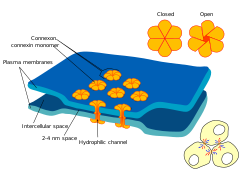
Gap Junctions - Also known as macula communicans. They are made up of hydrophilic channels. Such channels help in their function of connecting the cytoplasm of the cells


Hemidesmosome - They are very similar to desmosomes. What differs is that instead of desmogleins, desmopenetrin proteins are used

Sunday, October 5, 2014

About Midterm Time

I am struggling. I am struggling to stay afloat this semester. So much is going on in but mostly outside of the classroom. People are pressuring me with many other tasks when I'm just trying to take care of my own business. All I can do is sleep just to stay sane. Ugh.

Overall, I'm not doing well in the class. I'm behind in assignments. But what is really bothering me is that I haven't found a great way to study yet. Reading the book helps, but I'm not retaining the information very well. I need to figure this out quickly. Or maybe I'm doing alright. Who knows. Maybe my grade on the first exam will be able to provide me with some insight.

Please pray for me.